Mastering Risk Management and Leverage: What/How/Why
- Jul 21, 2024
- 4 min read
Updated: Dec 15, 2024
Today, we're diving deep into the art of managing risks, understanding the importance of stop-loss, and embracing losses as part of the trading journey rather than avoiding them and feeling guilty about them.
The Importance of Stop-Loss.
A stop-loss order is a trader's best friend. It's an automated instruction to sell an asset when it reaches a specific price, preventing further losses. Think of it as a safety net, ensuring that even if the market doesn't move in your favor, your losses are capped at a level you're comfortable with. Remember: Hitting a stop-loss doesn't label you as a bad trader. On the contrary, it signifies that you're a trader who knows how to manage losses effectively. Managed losses, where risks are calculated and predetermined, are a testament to a trader's discipline and foresight. Every trader will face losses; what differentiates a experienced trader from a beginner is how they handle those losses. Managed Loss vs. Unmanaged Loss Managed Loss: This is the loss you've anticipated. You've set a stop-loss, calculated the risk, and are willing to accept that loss as part of your trading strategy. EMAs were broken, resistance was broken and failed to hold the price, total loss is -4%

Unmanaged Loss: This is dangerous territory. Either there's no stop-loss in place or it's constantly being moved to avoid being stopped out. This approach can lead to significant, unplanned losses. As an example, we resulted in 1 stopped position but with -16% while our regular is -4% (which equals to 4 positions being stopped)
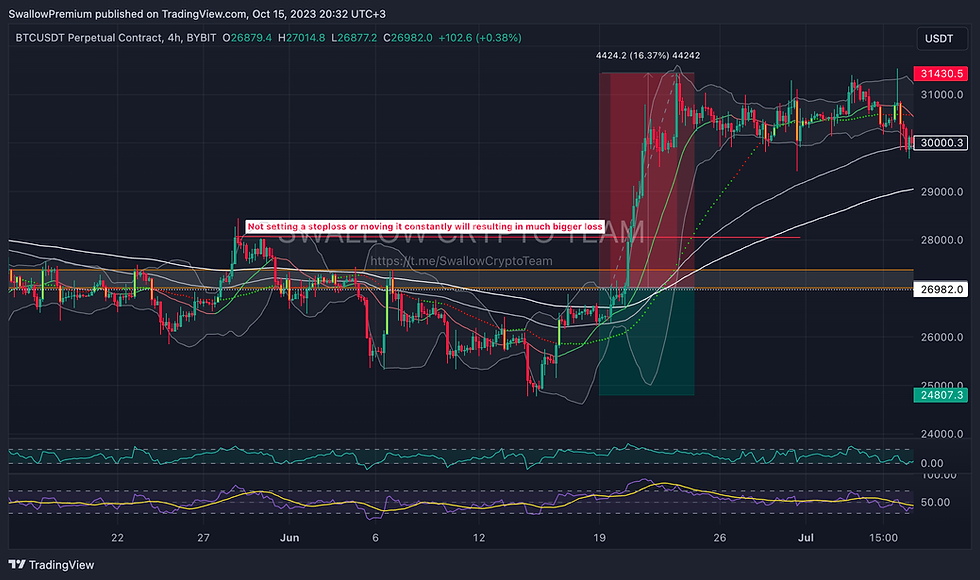
Scenario: Imagine you've decided to invest in Bitcoin (BTC). The current price of Bitcoin is $26982, and based on your analysis, you believe there's potential for drop. However, you're also aware of Bitcoin's volatility.
- Managed Loss: Before making your investment, you determine that you're willing to risk a 4% loss on this trade. Therefore, you set a stop-loss order at $28,076 (4% above the current price). If the price of Bitcoin pumps to $28,076, your position will automatically be bought, ensuring your loss is cut at your loss amount is 4%
- Unmanaged Loss: Instead of setting a stop-loss, you decide to "go with the flow," believing Bitcoin's price will recover from any pumps that happen during a bearish market. However, Bitcoin's price starts to push. It pumps to $28,076, then further to $31.430, and continues its upward trend. Without a stop-loss in place, you're now facing a loss of 16% or more. If you keep adjusting your stop-loss, hoping for a price recovery, you risk even greater losses and eventually a liquidation.
One of the biggest mistakes, especially among beginners and sometimes even advanced traders, is the failure to manage a losing trade. Often, they might adjust their stoploss, taking on a loss that's disproportionately large. Remember, managing losses is part of the game! Damage is done only if the loss is not managed. While everyone loves making profits, sometimes you have to focus on what you hate, which is taking losses! Leverage and Overleveraging: Maximizing Profits or Courting Disaster?
In the of crypto trading, leverage can be both a powerful and helpful or a a destroyer. While it can amplify profits, it can also magnify losses. Let's break down the concept of leverage, the risks of overleveraging, and the importance of using it judiciously.
The Double-Edged Sword of Leverage
Potential for Higher Profits: Leverage can amplify gains. If you predict the market movement correctly, your profits are multiplied by the leverage.
Risk of Magnified Losses: The flip side is that if the market moves against you, your losses are also multiplied. This can lead to significant losses or even a margin call, where the position would demand additional funds.
Fees and Costs Associated with Leverage
Leveraged trading often comes with fees, such as:
Interest Costs: Since you're borrowing money, there's often an interest cost associated with holding a leveraged position overnight.
Margin Fees: Some brokers charge fees based on the margin (borrowed money) used.
Liquidation: If the market moves against you and your account balance can't cover the potential loss, your position might be automatically closed, leading to a total loss of your initial investment.
Choosing the Right Leverage: Examples
Scenario 1: If Bitcoin is trading at $50,000 and you believe it will rise, you might use 2x leverage to buy $10,000 worth of Bitcoin with just $5,000. If Bitcoin rises to $55,000 (10% of market movement so with leverage it will be 20%), your profit is $1,000 (instead of $500 without leverage).
Scenario 2: Using the same initial conditions but with 10x leverage, if Bitcoin drops to $49,000, you'd lose $1,000, wiping out 20% of your initial investment on just 2% of market movement.
The key takeaway? While leverage can amplify profits, it's essential to understand the risks and use it judiciously meaning with lower leverage you can apply bigger stoploss zone.
Conclusion
In crypto, profits are undeniably strong factors, but the true art lies in managing risks and ensuring sustainability. As traders, we must strike a balance between the potential of leverage and the importance of risk management. While leverage can be a powerful tool in our arsenal, it's imperative to use it responsibly and be aware of the associated risks and fees. After all, in the volatile crypto space, it's not just about maximizing profits but also about preserving capital. As the legendary trader Paul Tudor Jones wisely said, "If you have a losing position that is making you uncomfortable, the solution is simple: Get out!" And always remember, "It's not about the money you make, but the money you keep." ----------------------------------------------------- Free Telegram: https://t.me/+xJEc_EYala4wZjE0


