Change These 5 Trading Habits Before They Blow Your Account
- 6 days ago
- 4 min read
Most traders do not lose because they know nothing about charts. They lose because they repeat the same bad habits until the account cannot survive anymore.
A trader can identify support and resistance levels. A trader can understand market structure. A trader can spot clean setups. But if the habits are bad, the account still bleeds.
Here are five habits that traders need to change if they want better results.
1. Stop Re-Entering the Same Trade After a Loss
This is one of the fastest ways to destroy a good trading day. You take a trade, and it loses. Then you look at the same setup again and think:
“Maybe I entered too early.”
“Maybe the real entry is lower.”
“Maybe I should take it again from another level.”
That is usually not analysis. That is revenge. After a loss, your mind wants to fix the pain quickly. The chart starts looking personal. You trade to get your money back - that's dangerous.

A lost trade already gave you information. It told you that your first idea did not work, or your timing was wrong, or the market was not ready. If you enter again right away from a different level, you may be trading the same weak idea twice.
One loss becomes two. Two losses become a red day. A red day becomes a broken plan.
After a loss on one setup, step back. Do not re-enter the same idea unless the chart gives an entirely new setup with fresh confirmation. A small bounce, a small candle, or “it looks better now” is not enough.
You need a new reason. That can be a new structure break, a clean retest, a strong rejection from a key level, or a proper shift in market direction. If the reason is only “I want my loss back,” skip it.
2. Wait for Proper Confirmation, Then Trade With Real Size
Many traders enter too early because they want a smaller stop. The logic sounds smart at first: “If I enter early, I can use a smaller size and smaller risk.”
This is where many traders hurt themselves. They enter early with small size, get stopped, enter early again, get stopped again, and then complain that the setup does not work.
It is usually better to wait for the market to confirm the move, then enter with more confidence and a proper size that matches your risk plan.

Confirmation does not mean waiting forever. It means waiting for the thing your setup needs before you click.
For example:
If you trade market structure breaks, wait for a clear break and retest.
If you trade support and resistance, wait for a real reaction from the level.
If you trade trend pullbacks, wait for price to hold the trend area.
If you trade liquidity sweeps, wait for the sweep and the rejection.
3. Understand That the Problem Is Often Account Size
Many traders blame their skill when the real problem is account size. This does not mean skill is not important. Skill matters. But account size changes everything.
A small account puts heavy pressure on every trade. If the account is too small, the trader wants fast results. They start risking too much. They overtrade. They try to turn a tiny account into a big account in a few days.

If your account is small, you need to accept the reality of that account. You cannot trade it like a large account. You cannot expect full-time income from a tiny balance. You cannot force large results without taking large risk. - That is a mistake.
The account size must match the expectation. If the account is small, focus on process. If the process becomes strong, the account can grow over time. 4. Stop Moving Your Stop Loss Because You “Believe” in the Trade
A stop loss is not there for decoration. This is the point at which your trade idea is considered wrong.
If you move it only because price is getting close, you are no longer managing risk. You are avoiding the truth.
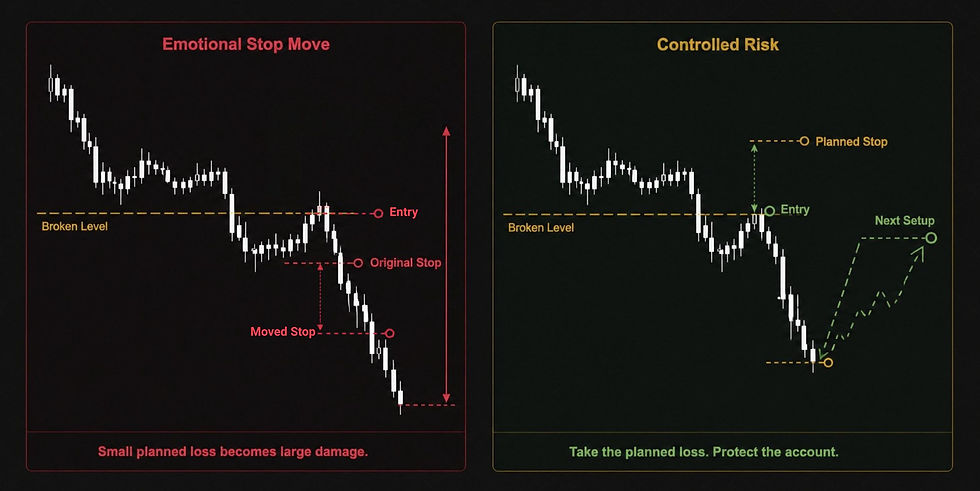
If the stop is below a retest low, it should stay there. If the stop is above a rejection high, it should stay there. If price hits it, the setup failed - That is trading.
Moving a stop without a clear reason creates unlimited risk. It also trains the brain to avoid losses instead of accepting them.
5. Stop Judging Yourself by One Trade
One trade means almost nothing. A single win does not make you a great trader. A single loss does not make you a bad trader. Trading is a series game.
The better habit is to judge your trading from a sample of trades, not one result.
Look at 20 trades. Look at 50 trades. Ask better questions:
Did I follow my plan?
Did I enter only clean setups?
Did I respect my stop?
Did I avoid revenge trades?
Did I manage risk properly?
Did I repeat my best setup?
That is how you find the real problem. Trading gets easier when you stop making every trade personal. A loss is data. A win is data. A missed trade is data.....Use the data. Do not turn every result into drama.
The Real Goal: Fewer Bad Decisions
No habit can make trading risk-free. Losses are part of trading. Even strong setups can fail. The goal is not to avoid every loss. The goal is to avoid stupid losses.
Judge your performance from a series of trades, not one result.
These habits sound simple, but they are hard to follow under pressure. That is why most traders know the rules and still break them.
Swallow Academy
Telegram: https://t.me/SwallowCryptoAcademy Best Exchange (BingX | -20% Off Trading Fees): https://bingx.com/en/activity/8thAnniversary?ref=IMZYPAVP6 Best Prop Firm (HyroTrader | -10% Off Challenge): https://www.hyrotrader.com/?coupon=SWALLOW


